Wednesday, June 18, 2014

Let them eat grass!

A lot of people who know me think that I either don't eat meat or that I only eat white meat.  The truth is more complicated than that.  But when you  are invited to a friend's house for dinner, it's considered impolite to ask "Is this beef grass-fed?" "Do you know your farmer?" "Can you tell me if this chicken walked in the sunshine?"

It's a weird thing to know your meat and some people truly cannot adjust their mindset to accept that the chicken they saw pecking in the grass one day will be dinner the next.  I guess it's a little too much like eating a pet when you've seen the animal frolicking in the sun.  Personally, I fall into another category.  I like to know without a doubt that the animal on my dinner plate lived the kind of life it was meant to live. 

So what does that mean?

It means fresh air, sunshine, a natural diet and habitat.  It means someone cared for that animal if it was raised by humans.  It means a cow living a cow kind of life and a chicken living a chicken kind of life. 

Ideally, we'd all have access to this kind meat in any grocery store we walked into.  The reality is far from that, however.  Part of the difficulty in knowing where our meat comes from stems from confusing labels.  The claims of packaging are often false and misleading.  For example, if a meat package says an animal has "access to outside" all that means is that a tiny door in a chicken house that houses tens of thousands of chickens is open.  Now chickens aren't the brightest creatures, so it's highly unlikely that a chicken across the house is going to say, "Hey, let me climb over 20,000 other birds to get me some fresh air."  They are going to maintain the status quo...pecking at a concrete slab covered in poop.  Likewise, think about the claim "vegetarian fed." Chickens aren't vegetarians.  They eat bugs...vegetarian fed typically means that they were fed a diet of grain absent of other dead animals.  So the fact that they aren't being fed dead cows is good because beef is not a typical part of a chicken's diet, but it's incorrect to assume that chickens are strict herbivores.  They are not.  They forage in the grass and eat bugs as a source of protein.  But they can't do that when they are isolated from their natural environment and fed a diet devoid of their natural fare.

It's easy to fool yourself into thinking that the package of chicken with a farm on the label and words like "natural, free-range, vegetarian fed" means that that meat was humanely raised and slaughtered.  But if you believe that, you are fooling yourself.

So what kind of life should an animal live?  A kind and humane one...the kind they would live if left to their own devices.  One devoid of antibiotics, growth hormones, unnecessary confinement and foods that aren't a part of their natural diet. 

In conventional practices, after a calf is weaned, it is sent to a concentrated animal feeding operation (CAFO).  This is pretty much cow hell.  They are packed nose to tail into one place, given no access to fresh air or grass and fed a diet that is outside the scope of their naturally occurring habits (at best, only grain--most likely GMO-grain; at worst, dead cows and pigs too diseased to be processed for human consumption).  They are also fed antibiotics to survive the close living conditions of feedlots and growth hormones to fatten them up faster.

Why does it matter if a cow is fed grain (i.e. corn) instead of it's natural diet of grass?  The nutritional profile of grass-fed beef is very different from the nutritional profile of grain-fed beef.  Grass-fed beef is much higher in omega-3 fatty acids, it is also has a different ratio of saturated fats (it is higher in stearic acid which is NOT associated with an increase in cholesterol levels), it's higher in conjugated linoleic acid (CLA), a fat that has antioxidant qualities. Grass-fed beef is also higher in other minerals, antioxidants and vitamins.  In addition, grain-fed cows are more susceptible to E. Coli.  All cows have E. Coli in their guts the same way that humans have a variety of bacteria in their bellies.  But cows fed a grain based diet don't have the right ratio of bacteria and, therefore, are less able to combat this naturally occurring bacteria.  Add sloppy processing practices and grain-fed cows can be a ticking time bomb of killer E. Coli. The stomachs of grass-fed cows are much more able to combat the E. Coli bacteria and therefore, are far less likely to pass on that bacteria to humans.  In addition, they don't need blanket antibiotics because they aren't crammed into close quarters with thousands of other cows and because farmers who raise grass-fed beef use different practices, they don't give growth hormones to fatten them up quicker.

But I don't eat grass-fed beef for the nutritional content.  I eat grass fed because anything else feels wrong to me.  I can't support a system that packs cows into a hellacious den of bacteria.  I can't support a system that rips calves away from their mothers and feeds them gruel and man-made hormones to fatten them up faster.  I can't support a cruel and unusual system of food management.

I buy grass fed because, in my mind, it's the only beef that's acceptable.  And that philosophy extends to pigs and chickens, too. 

For a long time, I felt that they only way to avoid eating CAFO meat was to avoid eating meat all together, but that wasn't something I wanted to do.  The truth is, I like meat.  It tastes good.  Last night, I blended ground beef and ground pork with some fresh rosemary and dried herbs, my husband fired up the grill and we had burgers so delicious I ate two of them and was stuffed to the gills.  I want to be able to do that and not worry about anything other than my waistline.

So what's the answer?  For me, the answer is knowing where my meat comes from.  I know my farmer.  Her name is Kelly; she graduated high school with my sister and brother-in-law.  She's super nice and adorable and most importantly, is kind to the animals she raises. 

But here's the thing...not everyone lives in an area where knowing your farmer is a viable option.  And not everyone can afford to take part in a CSA...hell, I can barely afford it, but I'm willing to make sacrifices in other places so that we can afford it.

"Clean" meat should be accessible to every person in this country.  No one should ever have to worry about the pathogens that might be in their food supply.  No one should ever have to wonder if the meat on their plate was mistreated when it was still walking around. 

Everyone should have an opportunity to eat well and without worry.

For more on this topic, visit Eat Wild.

Monday, June 9, 2014

What is a CSA?

When I tell people I joined a CSA, the question I hear the most is, "What's a CSA?"

Before I answer that question, I'll tell you why a CSA matters to me. In the English classes I used to teach, I would often organize the readings around a particular theme. In doing so, my students were able to gain a level of expertise and write with more authority (at least, that was the hope). 

One of my frequently used themes was the food industry, and how it's, you know, killing us.  But I always felt like something of a poser because I still shopped at the grocery store (and not just the outside perimeter) and bought packaged food. So I always felt like I needed to put my money where my mouth was--quite literally in this case.   

So when I read about the whole food CSA run by HighlandArt Farm, I knew it was the one for me!

Back the original question...CSA stands for Community Supported Agriculture. Basically, members of a community buy into a farm and receive shares each week all summer long. 

In my case, my money goes to support several different local farms since my farmer works with a bunch of other farmers to put together a "whole food" CSA. She offers meat, milk, yogurt, cheese, grain (bread and/or granola) coffee, and of course, veggies.


Because my family is small, I do a half share of veggies, which amounts to a small box of veggies each week, 6 lbs of meat, a gallon of milk, a quart of yogurt and a bag of coffee. I paid $400 for my veggie share and I pay $70 a week for the rest of it. Is it expensive? Yes. Is it worth it? Totally!

It's worth it for us as a family to have fresh veggies and pastured meat (more on why pastured meat matters in another post). But it's also extraordinarily important to the farmers who rely on their community for financial support. Many farmers are forced to supplement their income with other jobs during the off season. CSA farmers are less likely to rely on supplementary income and regularly report higher income levels, and therefore, they are able to focus on making their farms sustainable and profitable. CSAs also keep your dollars in your community, which helps to strengthen local economies. In addition, opting out of the industrialized food system is the best way I can think of to tell companies and government that we are capable of providing for ourselves and don't need the garbage they call food.

There are several ways to find local CSAs in your community.  Simply Google "CSA" with your county or town.  Visit eatwild.com.  You can also shop farmer's markets to support local farms and opt out of "Big Food."  Ask your grocers to supply local foods; if they know the demand is there, they will supply the goods.

For further reading on why eating local matters, check out the movie Food, Inc, based on Michael Pollan's The Omnivore's Dilemma.  Barbara Kingsolver's Animal, Vegetable, Miracle is also a terrific book with recipes and meal plans focused on seasonal foods.  

Thursday, May 29, 2014

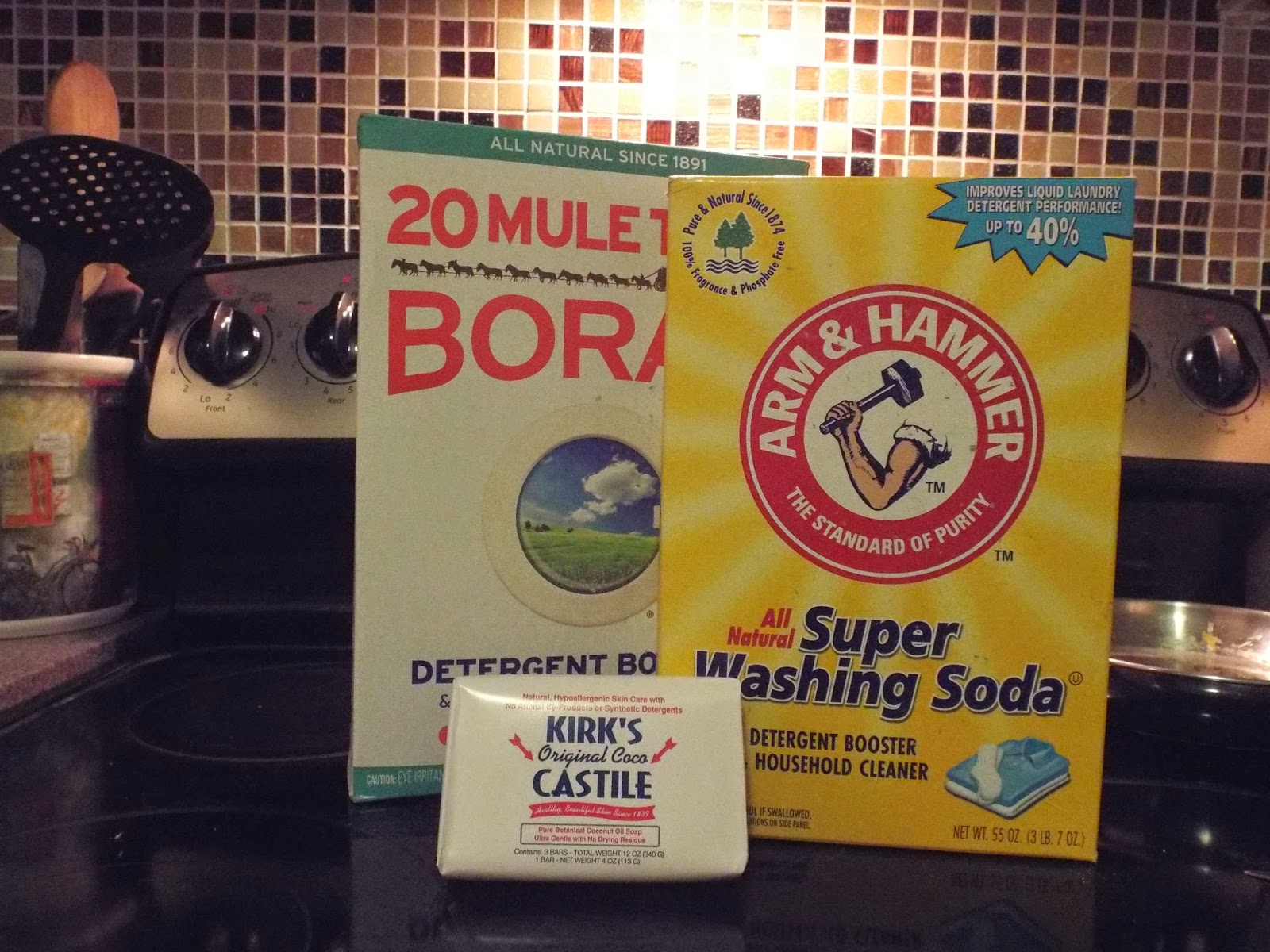
Today's Homemade: Laundry Soap

So I tried EcoNuts and I didn't love them.  Some of my clothes still had gudge on them after coming out of the dryer and I found myself constantly questioning if stuff was actually clean or not.  When you wash cloth diapers in the washing machine, you need to feel 100% certain that your clothes are clean as a whistle.

So I bought borax, washing soda and bars of castile soap to make my own.  I made it tonight, but I haven't had a trial run just yet.  I was going to throw some laundry in tonight, but it's late and I just didn't want to bother.


It's super easy to make laundry soap.  The only thing that was a pain in the neck was grating the bar of soap.  Next time, I'm going to chop it up and throw it in the food processor.

So here's the recipe (adapted from this):

1 C. grated castile soap
1 C. washing soda
1 C. borax
10 drops tea tree essential oil
10 drops eucalyptus essential oil
5 drops peppermint essential oil

Mix all ingredients and voila, laundry soap.  The essential oils you use are completely up to you.  I went with tea tree and eucalyptus for their anti-bacterial qualities and the peppermint I added simply to up the minty fresh smell.  The castile soap smelled so good, though, I almost didn't add any extra scent.


Use 1 tablespoon per laundry load, double or even triple for large or heavily soiled loads.  I'll probably use 2 tbsps. for my cloth diapers.


Tuesday, May 20, 2014

Today's Homemade: Trail Mix

Get ready for the easiest recipe ever.  Think of the simplest thing you've ever made.  This is easier than that.

Ingredients: 

Dried Fruit
Nuts and Seeds


Add all ingredients to one large jar.


Shake the jar.  That's really it.


I used dried cranberries, roasted pumpkin seeds and mixed nuts.  But you can use any combination of nuts and seeds that strikes your fancy.

PS: Sorry the pictures are kind of crappy.  I used my phone instead of my camera because I'm lazy.

Thursday, May 15, 2014

Ch-Ch-Changes

So here I sit, anxiously awaiting the end of the semester...tick tock goes the clock.

The end of the semester most likely means the end of regular posts.  I will try to keep posting a few times a week over the summer, but honestly my kids keep me much busier than my job, so most likely, I will slow down quite a bit.

What else is changing?

I've been toying with my beauty care and working out the kinks of these natural methods of cleansing myself.

I'm about four weeks into the no 'poo method, and last week, I started looking for an alternative.  The first week, I loved it and I felt like my hair looked and felt great! The second week, I started feeling oily on my off days and kind of itchy.  By the third week, I definitely felt itchy and was starting to search for alternatives.

Here's the thing, my hair was pretty nice beforehand, so maybe no 'poo works better if you feel that your hair doesn't react well to commercial shampoo.  But I still want to keep toxic chemicals off my hair and body as much as possible, so I found a recipe for a castile soap based shampoo that I've used twice now with moderate success (I'll write a different post with that recipe).

I'm also still tweaking the oil cleansing method.  Mostly, I'm trying to get the timing right in terms of when to do it.  I was doing it during the shower, but between that and the BS/ACV hair routine, my shower time had doubled (at least).  With two little kids, I'm looking to shorten my shower routine, not lengthen it.

The other thing was that I felt like the OCM was contributing to oiliness in my hair.  So I cut down to doing it only every other day--on the days I wash my hair.  But since that still made my shower time too long, I decided to go back to doing it at night.  I'm still going to do it every other day (especially since we're entering hot and humid season), but now I will do it the night before I wash my hair. 

Then on off days from the OCM and in the shower, I will just rinse my face with water and maybe exfoliate with a wash cloth.  I also made myself an ACV/water/rosemary EO facial toner that I like to use to combat any extra oiliness.

So that's where I am now...

BS/ACV hair care: doesn't look like it's for me.
OCM: I like it, just trying to work out the kinks.

Tuesday, May 13, 2014

Let it Go!

"One thought crystallizes like an icy blast: I'm never going back, the past is in the past!"


In a previous post, I talked about my son's speech delay, and the feeling of vindication when the new ear, nose and throat (ENT) doctor told us that everything from his snoring to his speech was connected. 

It's now nearly four weeks after he had tubes inserted into his ears.  The first week or two, we anxiously watched for signs of anything...signs of post-surgical infection, signs of improved hearing...or even better, signs of improved speech!

The good news is that he has definitely shown signs of improved hearing and speech and no signs of any negative outcomes from the surgery.  There is no bad news.

It's clear to us now that the poor kid couldn't hear clearly and had simply adapted to hearing everything muffled. Now that he can hear, he's trying harder than ever to repeat the speech sounds he hears and he's making progress so quickly. 

I think the biggest problem at this point is that a lot of his poor speech has become a habit and now that he can hear sounds better, he'll have to work to undo some of his mispronunciations.  I have no doubt that NOW is when speech therapy would be the most beneficial. 

But I have had a strange side effect from all this.  I want to forget that he ever had a speech delay.  I don't need to hurry his progression along; he's doing just fine on his own, but I just don't want it to be a thing anymore.

Like Elsa, the Snow Queen, I just want to let it go and move on with the next chapter of our lives. 

Monday, May 12, 2014

The Art of Doing Nothing

The other day a student I was tutoring asked me what my other job is.  The way he said it, it was taken for granted that I do, in fact, have another job.  I do not, in fact, have another job.  At least not one that pays me a paycheck.

But without hesitating, I answered, "My kids."

And really, I consider them to be my "real job" and this tutoring gig as a side thing.  Tutoring is definitely a hell of a lot easier than my real job (and it's where I write most of my blog posts).

All the same, it still blows my mind sometimes that I have these two beautiful little kids.  Kids tend to think of their parents as pre-existing entities--as if we were born into this world as Mom and Dad.  But Mom and Dad often have to remind themselves on a daily basis that that's who we are now.  We're not 17 without a care in the world.  There are mouths to feed, bills to pay, jobs to attend to.

But I digress.

The point is today I worked my real job and it was blissful.  Today was one of those beautiful days when I truly felt like I was doing it right.

What did we do, you ask?  Not a whole lot, I answer.

We didn't go to the park, though we were invited.  We didn't go to the library, though we have books to return.  I didn't do the dishes or laundry, though both need doing.  We didn't get in the car, go anywhere or buy anything.

But it was a hell of a good day.

We did take two walks around the neighborhood.  I did have a picnic lunch out on the lawn with my big boy while the baby napped.  I did take a video of my big boy spinning circles in the sun.  We did laugh, and play, and eat chocolate that melted on our fingertips...even the baby (though I'm not sure his had a chance to melt before he shoved the whole thing in his mouth).

Now it wasn't an entirely perfect day.  There was room for anger and harsh words when my big boy stood at the bottom of the stairs yelling "MOMMY!" while I tried to get the baby to sleep.  There was the baby who would not let go of me so I could go to the big boy.  But for once, I said, "What good will getting angry do?"  And I handled the 3-year-old's tantrum without having one of my own, and the baby eventually let go and slept alone for an hour.

Today I was the kind of mother I want to be every day. 

Wednesday, May 7, 2014

Vegetarian Recipe: Sweet Potato Black Bean Chili

This blog originally started as a place for me to post recipes for homemade, from scratch food.  I especially wanted to focus on things that most people probably buy at the store, like bread, yogurt and granola.  Well, along the way, I got sidetracked by homemade body products, but today, I go back to my roots. 

Today's meal plan calls for chili.  Initially, I was going to say forget it because I forget to take meat out of the freezer, but I had some sweet potatoes that needed to be used up, so I figured I'd find a vegetarian chili recipe.  And that's what I found here.  But I felt like the recipe needed more than one potato, and I'm almost pathologically incapable of following a recipe as it's written, so I made some changes.  I do recommend hopping over to that page because it has beautiful pictures of the recipe...something this post will not have.

Also, when you are prepping food with children, always plan for it to take double the amount of time it should...here's a rough timeline of getting dinner ready this morning.

8 am: Put the baby in the high chair while I chop onions and garlic.
8:15: Take the baby out of the chair because he's bored, return to chopping vegetables.
8:30: Get the older child a snack; get the baby the same snack as he is the world's hungriest baby.
8:31: Start to put the baby in his chair to eat said snack, realize he has a poopy diaper.
8:35: Change the baby's diaper, wash hands, return to chopping veggies.
8:40: Pull a chair over to the counter because older child must see what you're doing at all times.
8:44: Pick up the baby and comfort him after he falls over.
8:46: Rinse beans one-handed while holding baby.
8:50: Put baby back in chair since he's recovered from his fall (which, by the way, wasn't that bad of a fall; he's weathered worse).
8:55: Let older child help you stir completed chili...cover and walk away.

Why can't I drink at 9 am?

Anyway, here is the recipe.  I hope it's as tasty as it sounds, I'll update with a verdict after the hubs eats dinner.  I like that the recipe calls for cocoa and cinnamon because they will add a nice depth of flavor, something that meatless chili may lack.

Ingredients
  • 1 medium onion, chopped
  • 2 medium carrots, peeled and chopped
  • 3 small celery stalks, chopped
  • 3 medium sweet potatoes, peeled and cut into 1⁄2-inch pieces
  • 4 garlic cloves, chopped
  • 1.5 tablespoons chili powder
  • 2 teaspoons ground cumin
  • 3 teaspoons unsweetened cocoa powder
  • 1 scant teaspoon ground cinnamon
  • ground sea salt and black pepper
  • about 28-ounces canned diced tomatoes, including the liquid
  • 1 can black beans, rinsed and drained
  • 1 can kidney beans, rinsed and drained
  • about 2 cups OR one 14 oz. can chicken or vegetable broth
  • Garnishes: sour cream, sliced scallions, sliced radishes, guacamole, shredded cheddar cheese
If you like heat in your chili, you can add more cumin or throw in a teaspoon or two of cayenne pepper or hot sauce.  Hubby and I don't do spicy, so the cumin is enough for us.
 
The original recipe called for sautéing the onions and other veggies on the stovetop, getting everything nice and brown and yummy.  If you have time and want it to cook it that way, go for it.  Throw some olive oil in a pan, cook the onion until translucent, add the rest of the veggies, including the garlic, let everything soften slightly and turn slightly brown.  Then add the canned goods, broth and spices.  Let everything simmer together for about an hour.
 
I have to work today and probably won't even be home for dinner, so I literally threw everything into the crockpot, stirred it up, turned it on low and ran out the door. 

Monday, May 5, 2014

Today's Homemade: Body Wash

I made my sister a homemade body wash last week, and she loves it.  It gets nice and soapy on a body pouf (I'm sure a washcloth would be just as effective), and it smells great!

The recipe is so easy.

1/2 Cup Dr. Bronner's Liquid Castile Soap
4 TBSP vegetable glycerin
3 TBSP sweet almond oil
10ish drops of essential oil

Now obviously, you can use unscented soap and create any flavor palette you want, but my sister likes citrusy smells, so I used the orange scented soap and sweet orange essential oil.  I mixed the whole thing in a pint sized mason jar and found that it was only half full, so I added the ingredients all over again to make a double batch.

Shake it all up before you use it just to make sure that everything is well mixed.  I liked this recipe because it doesn't call for water, which can breed bacteria.

She loves it...frothy and fragrant, and she feels nice and clean afterward (I think, I haven't actually asked her, but she hasn't complained about feeling grimy).  As one of my few readers, she can chime in with a comment if she wants to add anything.

A couple notes:
The original recipe called for fractionated coconut oil, I don't have that, so I went with sweet almond.  Also, this really should be stored in a glass bottle because the essential oils can cause plastic to breakdown.  Ideally, it would be stored in a glass pump bottle, but if you can't make that happen, just pour a small amount onto a loofah or washcloth, rather than dipping into it....you want to try and avoid potential contamination.

My mother wants lavender, so that will be my next batch...then maybe I'll make one for myself...I'm thinking peppermint for me.

Thursday, May 1, 2014

No 'Poo

Let me start by saying I hate the name "no 'poo."  It reminds of a little conversation I once had with my niece.  She and my son were snuggled in a double stroller under a Winnie-the-Pooh blanket as we were about to take a walk.  The blanket was white with brown outlines of Pooh Bear.  Near the edge, the outline got cut off and it just looked like a brown smudge.  She looked at me and said, "Auntie, there's dirt of this blanket."  I said, "No, that's just Pooh."  She said, "EWW! Why is there poop on this blanket??"

So that's what I think of every time I hear "no 'poo."

But, unfortunately, that's the name of this hair cleansing method...and I can't change it.

Going no 'poo is fairly straightforward, though some people have not had much success with it.  I seriously wonder if the success of this method is tied to your particular body chemistry or if people did it wrong or gave up too soon.

Here's the thing with natural solutions, they tend to take a bit longer to kick in than commercial/mainstream methods.  But we do them because we want to avoid the chemicals and possible carcinogens that are rampant in those mainstream products.

So what do you need to go no 'poo?
  • Baking soda
  • Apple cider vinegar
That's it.  Assuming you already have water and measuring devices.

Here's what you do. 

Mix a tablespoon of baking soda with a cup of warm water.  Stir the BS so it dissolves.  Pour that over your head in the shower and massage it into your scalp.  You're really only concerned with your scalp and roots because that's where the oil comes from.  Leave it on for a minute while you soap your other body parts.  Rinse it out.

Make sure you rinse it really well because next comes the vinegar and you want to avoid having your head become one of those fifth grade science volcanos. 

Now mix a tablespoon of ACV with warm water.  Pour that over your head.  This time, focus more on the length and ends of your hair than your scalp/roots.  Rinse that well.  You will smell slightly like vinegar until your hair is dry.  Once it's dry, the vinegar smell evaporates.

Could it be any easier?

You shouldn't use this daily and you shouldn't switch between regular shampoo and this method.  I do this every other day.  My hair does tend to look a little "unwashed" on my in-between days, but I'm hoping that once my scalp adjusts its natural oil production that I can skip two or more days between washings. 

The argument for going no 'poo is that regular shampoos strip the natural oils (aka sebum) from your scalp and hair, and your scalp goes into overdrive trying to replace those lost oils.  That's why we end up looking like grease-balls between shampoos and using conditioner to replace the lost oils.

Now, some have said that there is a bit of an adjustment period.  It may take a week or two for your scalp to like this new method and as a result you may look like a frizzy/greasy mess for a little while.  But supposedly, after you've worked through that period and retaught your scalp and hair how to live in synergy with each other and reap the benefits of natural oil production, you will have glorious,  frizz-free hair with lots of body and shine.  Plus you save money (not buying expensive shampoo and conditioner plus other styling products), and you keep all that toxic junk off your body.

For your in-between days and the possible adjustment period, plan on lots of ponytails, hats and other such bad hair day strategies. 

  • If your hair feels dry using this method, try the following.
    • Allow your hair to dry naturally
    • Apply a very small amount of olive or coconut oil to the length and ends of hair
    • Deep condition with a mashed banana or beaten egg
    • And make sure that you are rinsing the baking soda out thoroughly

  • If your hair feels oily, try the following.
    • Use less ACV
    • Use more baking soda
    • Switch to white vinegar
    • Keep the vinegar off the roots and scalp
    • Make sure you are rinsing really thoroughly!